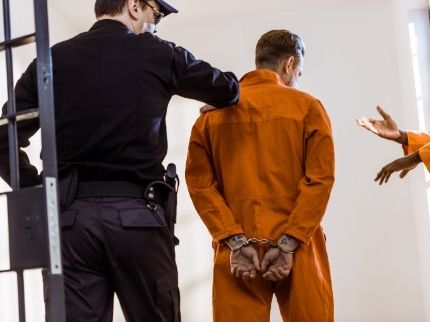
Another case of wrongful imprisonment, a man is exonerated 28 years later by DNA evidence with the help of The Georgia Innocence Project.
Oct. 4, 1978, Meriwether County, GA - An elderly rape victim was asked to pick out her assailant in a lineup and she chose the man in the middle, Jerome White. White was convicted and imprisoned based solely on eyewitness testimony, as have been most cases without hard evidence, historically speaking.
Yet, as state-of-the-art DNA evidence has recently proven, White was not her assailant, another man in the lineup was and his name is James Edward Parham. While White was imprisoned for 12 years, Parham went free… free to rape again, that is. (DNA testing was unavailable at the time of the Aug. 11, 1979, sexual assault in Meriwether County when White was prosecuted.)
As fate would have it, the guilty party, James Edward Parham, happened to be in that same jail on an unrelated arrest at the time of the lineup and was pulled from his cell along with other prisoners for witness ID. The victim had her assailant right in front of her and still did not choose the correct person! Perhaps this was because:
a) The victim, who was 74 years old at the time (now deceased), was asleep on her couch, in the dark, at 4am.
b) When Parham broke into her home, he raped and beat her so severely that her face was left partialy paralyzed.
c) Before he left the scene of the crime, he handed her a pillow and said, “Hold this to your face until I get out.”
d) The woman had prescription eyeglasses but she was not wearing them at the time.
According to an article by Bill Rankin:
On Sept. 28, 1979, the woman was shown a number of photographs, including White’s, and she said she was “almost positive” it was him. When she was presented the lineup of five men at the jail a week later, she said she was positive that White — not Parham standing just a few feet away — was the man who raped her.
“It was just a fluke [Parham] was put in the same lineup with Jerome White,” said Aimee Maxwell, director of the Georgia Innocence Project, which secured White’s exoneration. “This is a tragedy, on many levels.”
Rep. Stephanie Stuckey Benfield (D-Atlanta) told White she will support legislation to compensate him for the time he spent wrongly incarcerated.
Benefield released drafts of proposed legislation that says, beginning July 1, 2011, all photographic or physical lineups must be conducted by officers who have successfully completed eyewitness ID training. The legislation also says if a law enforcement agency does not have written protocols on eyewitness ID by Jan. 1, 2009, the agency can be denied state funding or state-administered federal funding.
Benefield said improved eyewitness ID procedures are necessary because there are only so many cases where DNA evidence can be used to identify the perpetrator.
The GBI supports improved eyewitness ID protocols, spokesman John Bankhead said Thursday. “Nobody in law enforcement wants to arrest the wrong person,” he said.
The accused, Jerome White, was defended at trial by the current U.S. Rep. Sanford Bishop (D-Ga.). White’ s laywer did not have him take the witness stand at his trial, however, when the jury found him guilty, he told the judge he didn’t do it. He states, “Then, when they put me back in the holding cell, I just cried,”.
In 2004, after receiving a letter from White, while he was in prison, The Georgia Innocence Project investigated the case. The Project eventually learned that hairs linking White to the crime, through microscopic analysis, were still on file at the Meriwether County Clerk’s Office. They pursued the case on behalf of White and evidence showed that this hair did not belong to him, but to Parham, whose DNA was already in a state database.
White, now released, is the seventh man in Georgia cleared by DNA evidence and has stated that he supports passage of new laws setting protocols for officers to follow when gathering eyewitness identification evidence.
The Atlanta Journal-Constitution
Published on: 12/13/07
http://www.ajc.com/metro/content/metro/stories/2007/12/13/eyewitness_1214_web.html
Dec 19

The Times of India reports that paternity testing in India’s major cities is on the rise.
MUMBAI: It has been one of the original sins etched in the ancient testaments, but its practitioners are now feeling the heat, thanks to new age technology. Increasingly, Mumbai-based married couples who have had serious doubts about the child’s parentage are resorting to DNA finger-printing tests to establish the identity of the parent.
The state-run Forensic Science Lab at Kalina has so far received 40 blood samples from couples who are at war over the parentage of their infants. “We have been receiving these samples from police stations where criminal cases of harassment have been filed and also from family courts where there are ongoing legal disputes about the parentage,” FSL director Rukmini Krishnamurthy told TOI.
Mazagaon resident Praveen Salian is one of the many parents who went for the DNA test recently as he doubted that his two-year-old baby looked like anyone in his family. A radio officer on a merchant vessel, he had in fact separated from his wife a year ago, and filed a divorce plea in the family court.
When the case came up for hearing, the court directed the police to verify this contention by testing the DNA blood samples of the infant and the father. Salian’s plea was found to be true as the infant’s samples did not match with his own and the divorce was granted.
Legal experts fighting paternity suits say there has been an increase in the number of such cases — a by-product of the increasing marital disharmony amongst urban nuclear families. “The DNA test is recognised under the Indian Evidence Act, although it is not conclusive proof and courts still look at supporting evidence if the case is related to harassment and sexual abuse,” counsel Uday Warunjakar said.
Experts say there are two types of paternity suits filed where the DNA fingerprinting test are used. In the first case, a dispute arises over a property and there are many legal heirs claiming their right. “The legal heirs can be found out by testing the blood samples,” Warunjakar said. In the second type of case, which involves couples who doubt their spouse’s fidelity, the DNA tests are done after a harassment case or a divorce plea is filed by one of the partners.
This disturbing urban social trend has gained huge popularity in the west. According to the American association of blood banks, 30% of 3.54 lakh men who took paternity tests in 2003 were not biological fathers of the tested child.
But psychiatrists have a word of caution. “One out of every two case arises due to suspicion and an inherent martial discord between the family. If couples have doubts, then it is good that they conduct a DNA test. But the problems usually does not stop here,” said Harish Shetty, a Mumbai-based psychiatrist.
He says that couples should undergo proper screening and counselling before they undertake the DNA test. “There are other reasons for marital disharmony and they just find this as an excuse for separation. Even if the DNA tests reveal that the child is their own, things may not be the same again if ‘other’ reasons for disharmony have not been resolved,” Shetty said.
Oct 21
Hello, my name is Meagan Cantrell, welcome to my blog! I am the owner of DNA Identifiers of California which provides DNA testing services and products to organizations and the general public. You can visit my site from the link on the right side of the page.
Many of our clients ask interesting questions, which I track and compile in an effort to keep abreast of this ever-changing technology and it’s impact on our lives. I decided to start this blog in an effort to share that information, plus news and current events in the DNA and Genetics community. I hope you find my blog useful and informative. I’ll admit, I am excited to see how it turns out myself!
Enjoy!
Oct 20